






Growing Irises in the The Cold Midwest
By Robert L. Bledsoe, permission granted by Society for the Louisiana Iris, chapter from The Louisiana Iris, The History and Culture of Five Native American Species and Their Hybrids, 1988 publication by Texas Gendener Press.
|
|
|
|



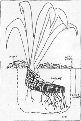
Growing Irises in the The Cold Midwest Only a few years ago Louisiana irises were considered not well suited to cold climates. Due to efforts of several growers and attention to certain details this no longer seems to be true. Amazing progress has been made in culture in the Great Plains region and other very cold areas. These descriptions are specific for Sioux Falls, South Dakota, but should be applicable to many other foreign and domestic locations with similar climates. Sioux Falls is in plant hardiness zone 4 and is subject to extreme temperatures in both winder and summer. A low of -25°F (-32°C) can be expected most winters whether there is heavy or minimal snowcover. A high of 102-108°F (39-42°C) occurs in July and August. Average precipitation (rainfall and melting snow) is only 24 inches (60 cm.). The growing season is usually not more than 5 months. The Louisiana bloom covers a very long season for those who grow a large number of varieties. Bloom usually begins the second week in June with peak bloom the last week in June or first week in July and extends to the end of July. Snowcover is variable, more than 70 inches (175 cm.) In 1983 to barely covering the round in 1981. One cannot depend on snowfall as the sole method of winter protection. Performance and popularity of Louisiana irises in Sioux Falls continue to improve each year. Acceptability of beardless irises now compares favorably with Louisiana and California. Record bloom performances were recorded in 1983 and 1984. Heavy snowfall seems to improve the blooms. In 1984 more than 250 varieties had bloomed by the end of June. These included new and older cultivars and species, many of which originated in south Louisiana. Efforts of eight Australian hybridizers are now represented. This is strong evidence as to the workability and merit of the cultural procedures which follow. Louisiana irises will grow and bloom in most locations except deep shade and close proximity to trees and large plants. Other types of protection (walls, fences etc.) Are advantageous. In the coldest climates certain varieties may not perform well in the most open locations. Transplanting to a more protected area will generally give improved performance. SOIL PREPARATION AND THE ACID BED The soil in this area is slightly alkaline, pH 7.1-7.4. The preparation and maintenance of an acid bed is important to growing and blooming Louisianas. A common method of acid bed preparation is to rototill thoroughly into the soil cow or sheep manure, coffee grounds, pine needles or evergreen clippings, rotted straw and peat moss. Top the prepared soil area with aluminum sulphate and water in. ALUMINUM SULPHATE IS USED ONLY IN THE INITIAL PREPARATION OF THE ACID BED. DO NOT REPEAT ITS APPLICATION IN SUBSEQUENT YEARS. Use other acidifying agents and acid fertilizers as indicated below. The acid bed should be prepared at least a month before planting. An alternate method of acid bed preparation is the "rose bush" method. The area chosen is cleared and topped with aluminum sulphate about a month before the irises are to be planted. The aluminum sulphate is watered in with a watering can in order to avoid run-off due to heavy rains. When ready to plant a hole 15-18 inches (38-45 cm.) Wide and deep is dug for each rhizome and one proceeds as one would for a rose bush. In the bottom of the hole place a layer of rotted straw, peat moss or other acidic humus and top with a layer of acid soil. Add a layer of pine needles or other evergreen followed by a layer of acid soil. Then a layer of manure is added and this followed by a layer of acid soil. Finally add a layer of coffee grounds and cover with a layer of acid soil. Center each rhizome at an edge of a hole such that it grows into the area of the hole. Pack acid soil around the roots and sides of the rhizome and cover with pine needles. Each plant has ample space to establish a large clump in this excellent growing medium. When the clump exceeds dimensions of the hole (3-4 years depending on growth habits of the variety) it should be dug and replanted. Maintenance of acid bed conditions subsequent to planting is equally important. Acid maintenance and fertilization are closely related. Following is an excellent way to maintain acidity: A solution is prepared using one teaspoon of "Orthorix" per gallon (3.8 liters) of water. In early spring, after removal of the winter mulch, about one third gallon (1.3 liters) of this solution is applied to each established clump. Excellent results were obtained by this method over a period of four seasons. Late spring planting (early May through early June) is preferred. Irises planted at that time benefit by the heavy feeding program and are completely adapted by the following spring. Fall planting is also satisfactory, from August 15 thru early September. First year bloom may be decreased by each week the irises are planted after early September. Planting in late September or early October may delay bloom an additional year. Some varieties moved from warm growing areas may require two or three years to adapt to this climate. This is rare, but eventually they do make the transition. Louisiana irises should not be transplanted during hot weather, particularly during July. This is the second most important factor in successful culture of Louisiana irises in cold climates. The colder the area the shorter the growing season. It is essential to achieve the maximum growth possible during the available growing season. Hence a rigorous and controlled fertilization schedule is necessary. Liquid acid fertilizers are preferred to solid fertilizers of the azalea-camellia type. Best results have been obtained with "Rapid-Gro Evergreen and Azalea Food" (sometimes called "Acid-Gro"). Mix with water according to directions and start application about two weeks after treatment with the "Orthorix" solution. Continued fertilizer applications every 2-3 weeks until mid August have given excellent results. Supplementing the acid fertilizer with occasional does of "mushroom brandy" is optional but very advantageous. Wild mushrooms are collected in a plastic pail, covered with water and allowed to decompose for 2-3 weeks. Undecomposed material is used with more mushrooms and water to produce more "brandy". This liquid is an excellent fertilizer but has a very unpleasant odor and will attract flies. A tight-fitting lid on the pail is an aid in overcoming this objection. The "mushroom brandy" is particularly effective with Louisiana irises. It is believed to increase the fertility of soils by enzymatic action in freeing fertilizer chemicals previously locked in the soil. This is a heavy feeding schedule, but benefits are two fold. It causes the rhizomes to grow rapidly and develop fully in the short growing season. It also functions to inhibit dormancy or semi-dormancy in mid summer as often experienced by Louisianas in warm areas. The irises become better adapted to a later bloom cycle and the dormancy or semi-dormancy period is postponed until late October or November when it may be more beneficial. A year-round mulch of pine needles is applied to each iris clump. Other mulching materials can be used, but the pine needles provide extra acidity. A winter mulch of straw is applied over the pine needles in November. The straw is not spread loosely, but is cut from the bale approximately in cubes, about 5-6 inches (12-15 cm.) thick and laid over the bed like floor tile. This gives better coverage and keeps the straw from blowing off. The straw can be removed on warm days and replaced when the cold weather returns. The straw is removed permanently about April 15 in normal years. Problems may be encountered due to mice damage of the rhizomes. This can be controlled by putting boxes of "d-Con" in the beds before covering with straw mulch. Another problem associated with mulching is development of "mushiness" in spring after melting of a heavy snow cover. This can cause loss of bloom from well developed plants of certain varieties. This is controlled by cutting back the foliage before covering with straw in the fall and spraying each clump with a solution of 1/8 teaspoon (1-2 cubic centimeters) of "Agrimycin" and one tablespoon (20-25 cubic centimeters) of "Terraclor" per gallon (3.8 liters) of water. The spraying is repeated in early spring after temporary uncovering and also when the plants are uncovered permanently. The irises should not dry out during the growing season. If dry spells occur the beds need watering. A canvas soaker hose is a most efficient way to water deeply and economically. |